https://www.bestcpmnetwork.com/wm8r0f4h?key=71e22323cafc6f23c987737c78d66ca2 Dan's Gardening and Birding Blog

Sunday, February 16, 2014

Lettuce Blends/My Seed Orders Have Arrived - Part 2

In my last post (https://www.blogger.com/blogger.g?blogID=7818050104445836783#editor/target=post;postID=5185417455805835898;onPublishedMenu=posts;onClosedMenu=posts;postNum=1;src=postname) I talked about heirloom and artisan tomatoes that I order from seed catalogs.

Tonight I will talk about a couple of different lettuce blends I decided to try.  I previously talked about planting romaine lettuce, loose-leaf blend, and a mesclun blend in my post on January 30th, 2014:  http://dansgardening.blogspot.com/2014/01/planning-which-vegetables-to-plant-part.html.  I am still holding true to this, I am just trying a different loose-leaf blend and mesclun blend.

The first blend I will try is Summer Glory Blend from Park Seed:

Summer Glory Blend - Park Seed


From their catalog description:

We have chosen 7 varieties for this blend, including butterheads (Boston lettuce), crispheads (iceberg), Romaine, and loose-leaves. Several have stunning red highlights on their foliage; all are guaranteed tasty and crisp even into the dog days of summer! These are all premium named varieties, available as a mixture only here at Park Seed, where we know about long, hot summers!

This seemed like a winner of a blend to me since it contains types of lettuce my family enjoys plus it is supposed to hold up in the summer heat.

The second blend I decided to test is also from Park Seed and is called Salad Bowl Mix.  It contains mustard greens, arugulas, and lettuces:

Salad Bowl Mix - Park Seed

This blend is a mesclun mix similar to one I have planted in the past but they all vary slightly.  We shall see how these turn out.  An interesting part of gardening for me is to try different varieties to see if better ones can be found.

In my next post I will get back to birding with my results from the Great Backyard Bird Count.  I have captured some more photos, but I must give credit to my son for the one below.  It has been an interesting weekend for bird watching and tomorrow is the last day of the GBBC.


Mourning Dove and American Tree Sparrow


Until next time.


Saturday, February 15, 2014

Bring on the Heirloom Tomatoes/My Seed Orders Have Arrived! - Part 1

In a previous post (http://dansgardening.blogspot.com/2014/01/sorting-through-vegetable-seedsout-with.html), I discussed where I purchase my vegetable seeds.  In review, I use a combination of local stores and seed catalogs, some of which I also mentioned in a previous post (http://dansgardening.blogspot.com/2014/01/here-come-seed-catalogs.html).

This year I was able to find most of the seeds locally, however I did end up ordering from a couple of catalogs.  I thought I would share what I ordered to give you some ideas.

My first order was from Park Seed:

www.parkseed .com

The main reason I ordered from Park Seed is tomatoes.  In recent years I have been growing heirloom tomatoes, which I have found to be so much more flavorful and interesting that the run of the mill varieties.  Of course I also grow a grape variety and a paste/Roma type.

If you've ever looked in a seed catalog at heirloom tomatoes, you know just how many varieties there are. So how do you choose?  One option is to pick a seed mixture.  One of the best you will find in my opinion is the Heirloom Tomato Rainbow Blend from Park Seed:


All indeterminate and all bearing large, distinctive, delicious fruit!

Contains Aunt Ruby's German Green, Dixie Golden Giant, Black from Tula, Brandywine Red, Big Rainbow, and Cherokee Purple.

In keeping with the tomato theme, I mentioned above that I normally grow a grape tomato.  This year I decided to try something different which was new to the seed catalogs this year; it is called Artisan Blend. I ordered this type from Jung Seeds:

www.jungseed.com

Artisan Blend-Jung Seed Co.

Following is the description from The Jung Seed catalog:

Unique Appearance - Exceptional Flavor
Whether you're a master chef or a home cook, you'll love all the options these tomatoes bring to the table. The breeders of Artisan's focused on combining excellent flavor with unique colors and shapes. The results are these beautiful and tasty, round and elongated, striped and blushed cherry-type fruits that range from 1.5 to 2 inches in size, resist cracking and keep well. Indeterminate plants stay healthy and extremely productive over an extended period.

Similar to the heirloom blend above, this blend of grape/cherry type tomatoes looks very appealing to the tomato lover.

In my next post I will discuss some other seeds I ordered including some lettuce blends.

Also to come is some more bird photos and results from my participation in the Great Backyard Bird Count.


Until next time.


Thursday, February 13, 2014

The Great Backyard Bird Count is Here!!

Welcome back to my blog.  So is everyone ready for the GBBC which starts tomorrow?


Below is an instructional video:


Or follow these step by step directions:


You can also refer to my previous post on February 7, 2014 for more information:
https://www.blogger.com/blogger.g?blogID=7818050104445836783#editor/target=post;postID=1668912589834662466;onPublishedMenu=posts;onClosedMenu=posts;postNum=2;src=postname


Wanted to share some more bird photos, thanks to my son and his patience for capturing the following shots:


Blue Jay


Blue Jay

Finally, wanted to share this inspirational photo (by Gordon Matson) and caption:

A cardinal is a representative of a loved one who has passed. When you see one, it means they are visiting you. They usually show up when you most need them or miss them. They also make an appearance during times of  celebration as well as despair to let you know they will always be with you. Look for them, they'll appear.


Until next time.


Sunday, February 9, 2014

Planting Herbs/More Bird Photos

Today I replanted some herbs since my plants were about two years old, and not very healthy anymore. I threw out the old plants, discarded the soil, and washed the pots.

Then I re-filled the pots with fresh potting soil and replanted.  Today I planted chives and basil.  Parsley to follow once I buy more seeds.  We decided to plant two pots each of basil and parsley since those are the herbs we tend to use most often.

Once planted, I covered the pots with plastic wrap secured with a rubber band.  The pots were then placed in a warm room that gets a few hours of sun each day, in this case underneath the Boston fern in the dining room (south facing window).


It was a good weekend for bird watching as the foot of snow we got on Wednesday brought them out in force:

Dark-eyed Junco

American Tree Sparrow

European Starlings

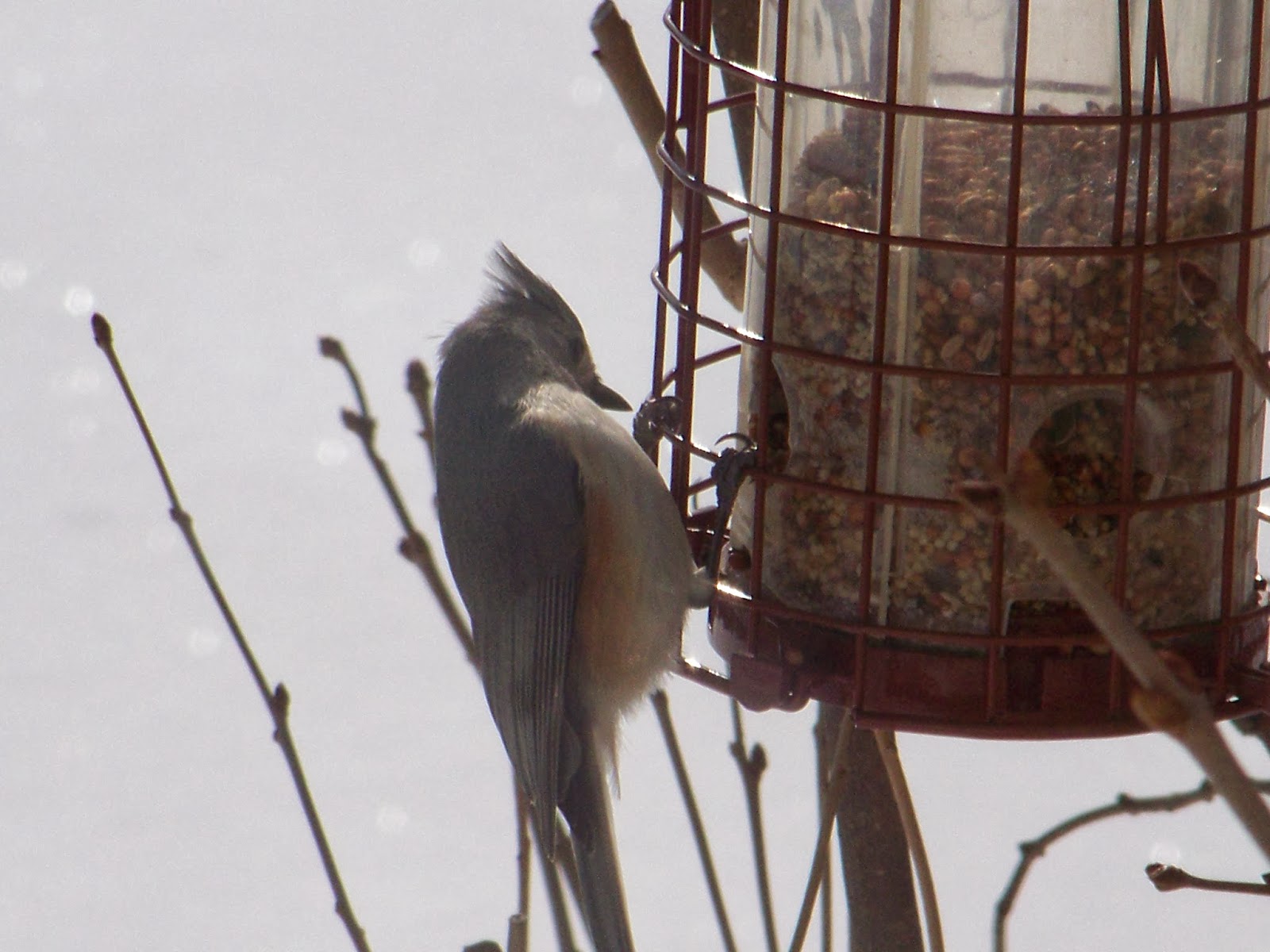
Tufted Titmouse

Until next time.


Friday, February 7, 2014

The Great Backyard Bird Count is One Week Away!

Welcome back fellow bird watchers.  Dust off your binoculars, cameras and bird identification skills.  See how many different species you and your family can observe over a four day period.  Teach your children all about birds.  The possibilities are endless.  It can all be done in as little as fifteen minutes.

The Great Backyard Bird Count (GBBC) starts on Friday, February 14th and runs through Monday, February 17th.  It is sponsored by The Cornell Lab of Ornithology and Adubon.  Following is a link to get you started plus a screen shot of the web page.

http://gbbc.birdcount.org/get-started/    


There are three easy steps to get started.  There are even mobile apps that can be installed and used on your smartphone to record your data.  The complete instructions can be found using the above link. There is an online bird guide to help you identify the more difficult species.

There is also a photo contest so you can have fun capturing photos of your favorite birds.

You may be thinking that you don't have enough time to participate.  If you can spare 15 minutes on any one of the four days, that is all you will need.  The minimum observation time is 15 minutes. You can do multiple observations each day if you want and submit a checklist for each observation. Observe at home in your backyard, or at your favorite park, or anywhere in the world.

Snowy Owl. (Photo by Ian H. Neilson, Alberta, CA, GBBC 2013)

You also may wonder how to count the birds when they are in constant motion and how to ensure you don't count the same bird twice.  Again, no worry since you count the maximum number of a species that you see at any one time during your observation period.  So if you see two chickadees at 9 AM and four at 9:15 AM, then your count for chickadees would be four, assuming you did a fifteen minute observation.

The GBBC was launched in 1998 and was the first citizen-science project which collects data on wild birds. "In 2013, Great Backyard Bird Count participants in 111 countries counted 33,464,616 birds on 137,998 checklists, documenting 4,258 species—more than one-third of the world’s bird species!"

So join the fun.  Until next time.

Tuesday, February 4, 2014

Winter Sowing

Winter sowing is a technique used to plant seeds outside during the winter,  Yes, you did read it correctly!
So why would you want to do that, and does it really work?

There are several advantages to winter sowing,  First of all, it doesn't take up space inside your house. Secondly, once the seeds are planted, they require very little or no maintenance.  Lastly the plants that grow are very healthy and hardy as they are already used to outdoor conditions.  They don't need to be hardened off.

Will it work for all seeds?  The short answer is no.

Winter sowing works best for cold hardy vegetables such as spinach, radishes, lettuce, onions, and leeks. Even tomatoes and peppers will germinate outdoors, but I found they sprout too late in the spring (later than the lettuce, etc.) to reach maturity during the summer.  Those will work better indoors to give them an earlier start.  I had really good luck last year with lettuce, onions, and leeks.  This technique will also work with cold hardy annual flowers and perennial flowers.

So what type of planting container should you use?  I found the best thing to use is a one gallon milk jug. Other containers will work also as long as they are transparent, have a lid,, and have enough room for 3 or 4 inches of soil and 3 to 4 inch seedlings.


To prepare the milk jug first wash it.  There is no need to sterilize it.  Next cut the jug roughly in half far enough up so that three or four inches of potting soil can be added.  Be sure to leave about two inches uncut to form a hinge.


Now poke or drill four holes in the bottom of the container for drainage.  This is very important since it will be outside in the rain and snow.  The top will be left off the top also to allow moisture in and also to prevent the plastic container from getting too warm.


Next add about three inches of potting soil or seed starting mix to the container.  Be sure not to use too heavy a soil as it will hold two much moisture.  Never use garden soil from your garden for starting seeds as it most likely contains bacteria and fungus etc. that could interfere with germination.

Add some water to "settle" the soil before planting.  Lightly pat the soil to form a level planting surface. Now you are ready to add the seeds.


Add seeds evenly but not too thick as to allow some space between the seedlings when they sprout. Cover the seeds according the planting depth suggested on the seed packet.  Lightly water again (I usually use a spray bottle).  Below is a photo showing Romaine lettuce seeds before covering.


Finally, tape the top onto the bottom of the container using clear tape if possible or a thin strip of duct tape. Using too much duct tape could block out too much light and affect germination.  Be sure to label with what you planted and the date.


The containers are now ready to be paced outside.  Choose a location preferably on the south side of your house so they will be protected from the prevailing wind and also exposed to the warm sun.  They can be placed on the ground, on a table, or really anywhere.  I have a small stone wall that I place mine on.


Until next time.


Saturday, February 1, 2014

Veggies 101-Onions

Each season I usually plant 3 or 4 varieties of onions.  Scallions are a staple in my garden every year.  I normally start these from seed indoors in late February or early March, and then transplant into the garden in mid May.  There are quite a few different scallions available, but I haven't found significant differences in them. Most are white but there a few red types.  I will discuss indoor seed starting as the time get closer.

Scallion Seed Packet Example

Next on my list is another staple, yellow onions (Stuttgarter type).  These are widely available as onion sets in many stores. These onions always grow very well and are an excellent onion to store over the winter (another future blog topic).

Yellow Onion Sets

Some years I also grow red onions which are also available as onion sets.

Red Onion Sets


Finally, my favorite onion I grow is the Spanish Sweet Yellow onion.  These are not available as sets so I normally start these from seed also.  Sometimes you can find these as plants but not every year at least in my area.  These onions can get very large and are very mild.  They store fairly well also.

Yellow Sweet Spanish Onions

Until next time.