https://www.bestcpmnetwork.com/wm8r0f4h?key=71e22323cafc6f23c987737c78d66ca2 Dan's Gardening and Birding Blog

Monday, March 3, 2014

Grafted Tomatoes - The Best of Two Worlds

Welcome back, and as always thanks for reading my blog.

Another fairly new development in tomatoes is grafted tomatoes.

I was really surprised when I read about these a few years ago.  I remember my grandfather and father grafting apples trees.  It was a technique to join two branches together making it possible to have several different types of apples on the same tree.

I would never have thought that grafting would be possible for tomatoes.

So why graft tomatoes?

In this case the reasoning is to use a hardy root stock that has greater disease resistance and graft it to a great tomato variety that by itself may be vulnerable to diseases.  For instance, many of the heirloom tomato varieties can be prone to disease.  The result is a plant that provides protection from diseases such as tomato mosaic virus, nematodes, verticillium wilt, and a number of other diseases based upon that specific root stock.

Grafted plants are available commercially, and it also possible for the home gardener to graft for themselves.

For more information, including how to graft yourself, see the following article in Organic Gardening:
 http://www.organicgardening.com/learn-and-grow/grafting-tomatoes

Tomato grafting technique


Tomato grafting technique


So where can you buy grafted tomato plants?  Following is just a few examples of grafted tomato plants:

Park Seed - Mortgage Lifter Grafted

http://parkseed.com/product.aspx?p=87766-PK-3&utm_source=google&utm_medium=cpc&utm_campaign=ppc_google_pla&CAWELAID=1284038358&catargetid=1459746967&cadevice=c&cagpspn=pla&gclid=CJXVs5yh9bwCFe1QOgodIQsA7g

Mortgage Lifter Grafted Plant


Hirt's Gardens - Costoluto Genovese Grafted Tomato

http://www.hirts.com/Mighty-Grafted-Costoluto-Genovese-Tomato/dp/B00BFI6QTU?traffic_src=froogle&utm_medium=organic&utm_source=froogle&gclid=CIiov_yh9bwCFYw7Ogod1RIAoQ


Territorial Seed Company - Legend

http://www.territorialseed.com/product/13153/538/?r=MWGBASE&gclid=CLSbt8Cl9bwCFYRxOgodcnQAKQ


Legend Grafted Tomato

This variety has shown resistant to the late blight which has become a very common and devastating tomato disease in recent years.

Finally, a nice graphic showing what to plant that will attract bees.  I am mainly a vegetable gardener, but I do plant wildflowers and sunflowers each summer in my gardens.


Until next time.


Friday, February 28, 2014

Talking Blue Tomatoes: Indigo Tomatoes/Peppermint Stick Chard

Welcome back.  I hope you are enjoying my blog.  As always I welcome comments and suggestions.

Yes, you did read the title correctly;  Blue Tomatoes!

Indigo tomatoes are a recent development that are now becoming available.  These tomatoes contain high levels of anthocyanins, which are antioxidant pigments (found in blueberries) that give the tomato a deep bluish-purple hue when exposed to sunlight.

One source of seeds for this new family of tomatoes is the Tomato Growers Supply Company (http://www.tomatogrowers.com/).

In their 2014 catalog they offer four varieties this year:


Indigo Apple
Indigo Apple #5319 (30 seeds) Early ripening and gorgeous dark fruit make this variety special. Heavy sets of unripe fruit show lots of purple due to the high anthocyanin level (the same powerful antioxidant found in blueberries). The stunning color is brought on by sunlight, and will eventually turn almost black. This variation of Indigo Rose is earlier and earns its name due to an especially good sweet tomato flavor. 70 days. Indeterminate.


Indigo Blue Beauty
Indigo Blue Beauty #5333 (30 seeds) Beautiful 6 to 8 oz. beefsteak tomatoes are uniquely colored, beginning as a stunning true blue where sunlight strikes the skin atop a bottom side of green. As they ripen fully, the purple deepens and eventually turns more reddish. That is when they develop their excellent flavor and are ready to harvest. Expect a heavy production of meaty tomatoes that are resistant to cracking and hold well on the vine until you are ready to pick them. Indeterminate. 80 days.

Indigo Blue Berries

Indigo Blue Berries #5368 (30 seeds) This is an amazing cherry tomato with very high levels of anthocyanin that show up as beautiful deep purple skin. Unripe fruit are amethyst colored, but ripen to almost black with a bit of brick red on the bottom. They have a delicious, plum-like flavor and are quite easy to grow. Their appearance is striking enough to turn heads at farmers’ markets or become the centerpiece of a home garden. 75 days. Indeterminate.

Indigo Rose
Indigo Rose #5301 (30 seeds) This is the original “blue” tomato released in 2012 by Dr. Jim Myers at Oregon State University. He used conventional breeding methods to get its dramatic purple color by drawing on a substance found in wild tomatoes from Peru and the Galapagos Islands. The substance is called anthocyanin, and it is a powerful antioxidant that protects us against disease and early ageing. Indigo Rose develops a dark purple skin wherever the fruit is exposed to direct sun, but it needs to ripen fully to develop good flavors. It is not ripe until the fruit softens, the bottom turns from green to red, and the flesh is deep red. Expect an abundance of these very beautiful 1 to 2 oz. deep purple fruits with rosy undersides and deep, brick red flesh. Indeterminate. 75 days. 


Another new vegetable you may be interested in, Peppermint Stick Chard, available from Rennee's Garden (http://www.reneesgarden.com/seeds/packpg/veg/chard-peppermint.htm).

Peppermint Stick Chard

This chard is named for it's beautiful two-toned stalks.  This chard can be used in both ornamental and edible gardens.  For those of you unfamiliar with Swiss chard, it's tender young leaves can be used in a salad, and the large mature leaves are very similar to spinach.  I grow Swiss chard every season and will be sure to try this variety.  I have better luck growing Swiss chard than I do spinach.  Swiss chard seems much more hardy and you will get a continuous crop all season long as it grows back quickly after cutting.

In my next post I will talk about another new development in tomatoes, grafted tomatoes.

Thank you for reading.


Tuesday, February 25, 2014

Worldwide Great Backyard Bird Count Results

I hope you enjoyed my post on February 18, 2014, in which I gave my personal results for the GBBC:

http://dansgardening.blogspot.com/2014/02/great-backyard-bird-count-results-photos.html

I thought it would be interesting to share some results of the GGBC on a larger scale.  Each year, this worldwide event has become more and more successful.  The GBBC was launched in 1998 as a joint venture between the Cornell Lab or Ornithology and the National Audubon Society.  Since then, more than 100,000 people of all ages worldwide have participated in the four day event each February.


So far this year, 141,912 checklists have been submitted worldwide.  Included on these checklists were 4,185 individual spices and 17,537,172 total birds.

These numbers will change constantly this week as checklists can still be submitted until this Friday, February 28th.

So check out the GBBC website (http://gbbc.birdcount.org/) for the interesting results  You can even see results for your local town or county.  Each year, participants take beautiful photos during the count and enter them in the photo contest included in the GBBC.  The deadline for photo submission is March 31, 2014.

Carolina Chickadee - Photo submitted by Georgette McGehee
Fort Polk North, LA, United States


So did you miss the GBBC and want to participate in a research project by observing and counting birds? Not to worry.

Another option is to join Project Feeder Watch, a winter long survey of birds (http://feederwatch.org/).


This project is sponsored by the Cornell Lab of Ornithology and Bird Studies Canada.  The simplified instructions are as follows.


  1. Sign up – If you have not yet signed up, join today! During the season, it takes a few weeks from when you sign up for your kit to arrive with your ID number and for your ID number to be activated in Your Data.
  2. Select your count site – Choose a portion of your yard that is easy to monitor, typically an area with feeders that is visible from one vantage point.
  3. Choose your count days – Select two consecutive days as often as once a week (less often is fine). Leave at least five days when you do not count between each of your two-day counts.
  4. How to count – Watch your feeders as much or a little as you want over your selected count days. Record the maximum number of each species visible at any one time during your two-day count. Do not add your counts together!
  5. What to count – Please count
    • all of the individuals of each species in view at any one time
    • birds attracted to food or water you provided
    • birds attracted to fruits or ornamental plantings
    • hawks and other predatory birds that are attracted by the birds at your feeders
The cost is $15 per year.  Right now the $15 membership includes the 2014-2015 membership also.  This year's count runs through Friday, April 4th.  Just enough time to get acclimated and ready for next year! Join soon as it takes a few weeks to become a member.

American Tree Sparrow

Northern Cardinal


Until next time


Another Beautiful Sunrise at My Home - 2/24/14


Saturday, February 22, 2014

More Winter Sowing/Seed Starting Supplies

Winter Sowing

In my post on February 4th, 2014, I described in detail the technique of winter sowing:  http://dansgardening.blogspot.com/2014/02/winter-sowing.html

It is a great way to start cold hardy vegetables in a low maintenance way.  The containers can be left outside until the seeds germinate in the spring.  Nature will take care of them.  Only after they sprout will they start to need care.

I originally planted romaine lettuce and leeks.  Tonight I planted two more containers, one with Lisbon white bunching onions (scallions), the other with red serpent loose leaf lettuce:


I placed the containers outside in the snow next to the ones I planted a few weeks ago.  Those can be seen on the left, just the tops of the jugs are showing.  We had a few snowstorms in between!


Below is a photo showing the seed starting soil that I used for this batch of winter sowing.  This type of soil (or a similar one) should be used for all of your seed starting. It is not advisable to use dirt from your garden since it probably contains bacteria and fungi that may interfere with germination and proper seedling growth.


Seed Starting Supplies

Today I did a little more browsing for seeds at some local stores.  I didn't end up buying any since I already have most of what I need.  However, it's always fun to look:


I did buy some seed starting trays.  I will use these to start tomatoes and peppers indoors in mid March. That will give then enough time to grow to a decent size before they will be transplanted into the garden in late May or early June.


These mini greenhouses use what are called peat pellets.  When water is added, the pellets expand to about an inch or so high and provide a great seed starting medium.  They come with a clear plastic lid which creates greenhouse type conditions for the seeds to sprout.

 I will write a more in depth post on indoor seed starting when the time gets closer.

Finally, as an added bonus, A great sunrise photo that I took at my house during this past week:


Until next time.


Thursday, February 20, 2014

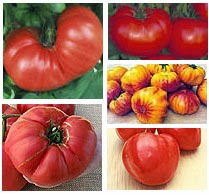
Heirloom Tomato Guide

There seems to be an ever increasing interest in heirloom tomatoes these days.  They are appealing in many ways.  Some people may be drawn to the many colors, sizes, and shapes available.  The true tomato lover knows that the real reason is taste.  You simply can't beat the flavor of heirloom tomatoes.

So just what is an heirloom tomato?  It is generally considered to be a variety that has been passed down through several generations of a family because of its desired characteristics.  In contrast, modern day hybrids have been bred for commercially desired qualities.

There are also disadvantages of heirlooms compared to the hybrid varieties.  They are more susceptible to some diseases and tend to be more irregular in shape.


At this point I can probably guess what you are thinking.  With so many varieties available, where do I begin?

One of the most complete sources (over 700 varieties) of heirlooms that I found is at the following link:

http://www.heirloomtomatoes.bizland.com/varieties.htm

This site gives a pretty good description of each variety.  But looking at this might just add to the question of which to choose.

My suggestion, unless you have a certain size and/or color in mind, is to try a variety.  There are quite a few selections available as seed packets if you start your plants yourself.  Some are even available as plants. Following is some of what I found, starting with the one I have been using for several years:


Contains Aunt Ruby's German Green, Dixie Golden Giant, Black from Tula, Brandywine Red, Big Rainbow, and Cherokee Purple.  Available as both seeds and plants.


The mix is composed equally of Bonny Best (red), Brandywine Pink (pink), Golden Sunburst (yellow), Black Krim (purple), Evergreen (green) and Djena Lee's Golden Girl (orange).  Available as seeds only.


This blend may contain black, pink, red or yellow Brandy wine, Cherokee Purple, Green Zebra, White Wonder and orange Nebraska Wedding. Large, meaty tomatoes have that rich heirloom flavor, unparalleled by today's hybrid varieties.  Available as seeds or plants.


BIG Tomato Collection #1077 (Assortment) For those of you who want to bring home the prize in a Giant Tomato contest, or anyone just wanting to impress their friends, this collection offers the BEST of the BIGGEST. Expect tomatoes from 2 to 5 lbs., and maybe beyond. Includes one packet each of: Goliath, Delicious, Church, German Giant, Virginia Sweets.


This collection contains a combination of heirlooms and modern day types.

I hope this post has been informative.

Until next time.

Tuesday, February 18, 2014

Great Backyard Bird Count Results & Photos

Welcome back.

Well another year of the GBBC is in the books.  Overall it was a good weekend for observing birds.  A snowstorm on Thursday into Friday brought out the birds in force with one notable exception.  On Friday, which was the first day of the count, there weren't many birds at the feeders as the storm was winding down; it was as if they were "staying put" until the storm was over.

Following is my observation reports for the 4 days of the GBBC:

2/14/14

2/15/14

2/16/14

2/17/14
I would love to hear you comments and also the results of others who participated in the GBBC.

Now for a few photos:

Dark-Eyed Junco

Female North American Cardinal

Male North American Cardinal

Downy Woodpecker
Until next time.


.


Sunday, February 16, 2014

Lettuce Blends/My Seed Orders Have Arrived - Part 2

In my last post (https://www.blogger.com/blogger.g?blogID=7818050104445836783#editor/target=post;postID=5185417455805835898;onPublishedMenu=posts;onClosedMenu=posts;postNum=1;src=postname) I talked about heirloom and artisan tomatoes that I order from seed catalogs.

Tonight I will talk about a couple of different lettuce blends I decided to try.  I previously talked about planting romaine lettuce, loose-leaf blend, and a mesclun blend in my post on January 30th, 2014:  http://dansgardening.blogspot.com/2014/01/planning-which-vegetables-to-plant-part.html.  I am still holding true to this, I am just trying a different loose-leaf blend and mesclun blend.

The first blend I will try is Summer Glory Blend from Park Seed:

Summer Glory Blend - Park Seed


From their catalog description:

We have chosen 7 varieties for this blend, including butterheads (Boston lettuce), crispheads (iceberg), Romaine, and loose-leaves. Several have stunning red highlights on their foliage; all are guaranteed tasty and crisp even into the dog days of summer! These are all premium named varieties, available as a mixture only here at Park Seed, where we know about long, hot summers!

This seemed like a winner of a blend to me since it contains types of lettuce my family enjoys plus it is supposed to hold up in the summer heat.

The second blend I decided to test is also from Park Seed and is called Salad Bowl Mix.  It contains mustard greens, arugulas, and lettuces:

Salad Bowl Mix - Park Seed

This blend is a mesclun mix similar to one I have planted in the past but they all vary slightly.  We shall see how these turn out.  An interesting part of gardening for me is to try different varieties to see if better ones can be found.

In my next post I will get back to birding with my results from the Great Backyard Bird Count.  I have captured some more photos, but I must give credit to my son for the one below.  It has been an interesting weekend for bird watching and tomorrow is the last day of the GBBC.


Mourning Dove and American Tree Sparrow


Until next time.