https://www.bestcpmnetwork.com/wm8r0f4h?key=71e22323cafc6f23c987737c78d66ca2 Dan's Gardening and Birding Blog

Sunday, September 13, 2020

The Harvest Continues - Onions and Potatoes

 Welcome back.  The summer was a hot one for sure and as usual it went by too quickly.  In my last post I featured garden harvest photos including tomatoes, peppers, and blueberries. 

It has been a good season for the garden even though it was very dry at times.  With some intermittent watering, I was able to get good results with most of the vegetables.

This year I planted 3 types of onions.  First, I started Sweet Spanish onions from seed in early March as I described in my April 15th post.  Theses are large sweet onions that also store pretty well.  Next, I planted Stuttgart, a standard long keeping yellow onion.  Finally, I planted Snowball onions, a white sweet onion.

Overall, the onion crop was good, although, they were somewhat smaller due to the dry conditions.  I have seen larger onions, especially the Sweet Spanish, which can get huge.


Sweet Spanish Onions


Plenty of Sweet

I recently also dug the potatoes.  This year I planted Yukon Gold and also Kennebec as I described in my April 18th post.  Both are great varieties and both store well.  Luckily, I have a good place to store vegetables in the basement of my 1850s era farmhouse.  The cellar stays cool even in the summer heat and never freezes in the winter.

Yukon Gold matures faster then does Kennebec, therefore those were harvested first around August 22nd.  I estimated about 30 pounds yield from about 25 hills.


Yukon Gold Harvest

On September 10th, I dug the Kennebec tubers, as the vines had pretty much died back by then.  I decided to take advantage of the fairly dry conditions.  I would not be disappointed in the results, about a 40 lb yield from the 25 hills.


Kennebec 


Kennebec Harvest

In summary, I was pleased with the onion and potato crop.  Last year, the potatoes did not do well at all due to an extremely wet Spring and early summer.

Even though most of the vegetables have been harvested, some still remain.  Stay tuned for upcoming posts featuring fall crops and the Fall garden cleanup process.


Monday, August 24, 2020

Simply Photos - Harvest Time

 Welcome back, today some photos of veggies I've been harvesting and also some flowers from the yard from the last few months.  Enjoy.  Next on the harvest list will be the potatoes and onions.  Stay tuned.


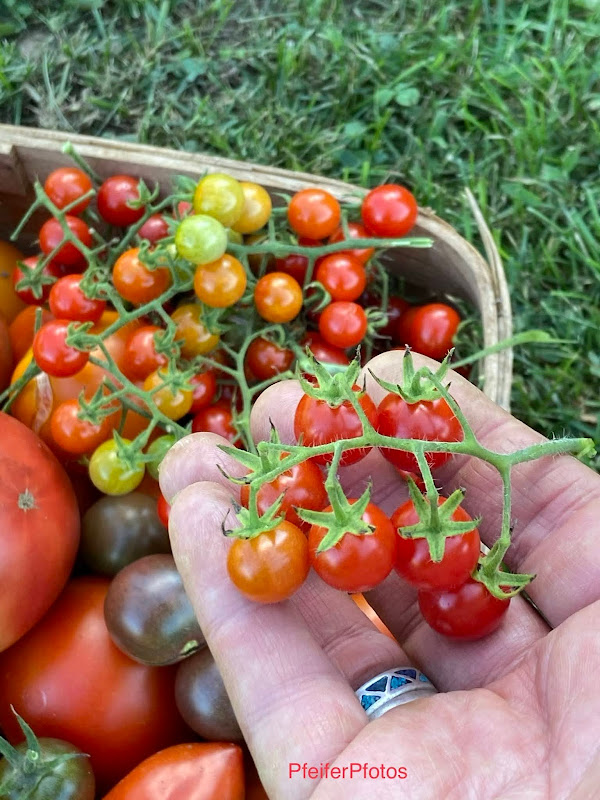
Heirloom Tomatoes (Including Cherokee Carbon, Big Brandy, Perfect Flame)


Matt's Wild Cherry (Heirloom)


Cherokee Purple (Good Example of How Heirlooms Can Be Irregular)


Black-Eyed Susan


Wonderful Blueberries


Bell peppers


Cayenne Peppers

Flox and Coreopis

Asters

Saturday, July 18, 2020

The Upper Garden

Welcome back.  Again it's been awhile since my last post, as I continue to be busy with gardening, and, oh yeah, working full time.  

In my last post I highlighted the lower garden, one of the 2 main gardens I plant.  I basically showed the whole planting process of that plot.  Since it's been almost a month, the upper garden is now well established so I will show up to date photos.  I did include the planting of peas in a previous post which are in the upper garden.

As is the lower garden, the upper is also packed with veggies.  In a year where I was going to cut back a little, well, it just didn't happen.  

Starting at the bottom, the upper garden starts off with peas as mentioned above.   These were planted on May 3rd, about a week before we got 3 inches of snow, the last snow of the season.  Due to the cold weather, only some of the peas came up.  Actually, it's amazing any came up.  So I replanted the ones that didn't germinate (pre-soaking them to speed up germination), and eventually I had a full row.

Finally the work paid off as I picked the first peas of the season,  We enjoyed them in a stir fry, they were so fresh and delicious.


Right next to the peas are a row each of scallions and leeks, both of which I started from seed.  The scallions are the Evergreen Bunching variety and the leeks are American Flag.  


As you can see, I also built another lettuce box out of scrap lumber from around the house.  This allows me to start a new batch of lettuce and greens to eventually replace the plants in the lower garden as we use them.  I have it covered in 30% shade cloth, as I do all the lettuce and kale at this time, to prevent the plants from growing too fast and/or bolting in the hot summer sun.

Next up are the potatoes.  I wanted to plant all Yukon Gold, however, I didn't initially buy enough seed potatoes for the whole plot.  By the time I went back to the local farm store for more, the Yukon Gold were all sold out.  I did manage to get some Kennebec which is a good white variety. My parents always grew Kennebec and were always happy with the results.  

From Wiki:  Kennebec is a medium- to late-maturing white potato. It was bred by the USDA and selected by Presque Isle Station, Maine, in 1941. 

From Wiki:  Yukon Gold is a large cultivar of potato most distinctly characterized by its thin, smooth, eye-free skin and yellow-tinged flesh.  

Both varieties generally yield well and also.store very well.


Overall I will end up with about 50 hills in the 4 rows.  As you can see, some didn't come up and I had to replant.  However, the replants are all sprouting so the end result will be good.  I already hilled the plants once.  I will do it again to ensure the new potatoes growing have plenty of soil to develop in without turning green.  Potatoes will turn green if exposed to sunlight.

Right above the potatoes are a row of green beans and also carrots.  The beans are a slender French type.  They are now blossoming and should be ready to pick in 10 days to 2 weeks.


Bean Blossoms
Bean Blossoms

The carrots I planted this year are from Burpee Seeds:

  
From the Burpee seed catalog:  We've combined five distinct colors of carrots in one special blend for a pretty rainbow effect that is sure to be noticed at the dinner table, even by the kids. After testing hundreds of carrot varieties, we developed this easy-to-grow mix of five crispy carrots: Atomic Red, Bambino, Cosmic Purple, Lunar White and Solar Yellow. Smoothly tapered roots grow to 8" x 2" in loose soil.

I am looking forward to harvesting these in the fall.

At the top edge of the garden are pumpkins, sunflowers, and pole beans.    

The last few seasons I have been having problems with sunflowers.  When planted, birds would eat the buried seeds right out of the ground, which I thought was very strange.  How do they know the seeds are a half inch under the soil?  Then, the plants were eaten off by woodchucks, the sunflowers being the only plants in both gardens that were bothered.  At times I have trouble with woodchucks, I am usually able to live trap and relocate them.

So this season I have had tried something new.  I built yet another box to use for the sunflowers.  After planting, it was covered with netting until the plants reached about 6 or 8 inches, then the netting removed, and the plants thinned and some moved outside the box.  So far so good.  I will keep a look out for varmits.

Some of the pumpkins I bought as plants, some were planted from seed.  I have Jack O Lantern and some other large varieties from Livingston Seed including Big Moon.


As always, thanks for reading.  More updates to come soon.


Monday, June 15, 2020

Gardening Time - The Lower Garden

Welcome back.  It's been awhile since my last post.  To be honest, I've been busy planting.  And planting.  And planting.  Every year I say I am going to cut back, however, this year the gardens are once again full.  For those of you who follow my blog, you know I have 2 main gardens, the "Lower" and "Upper'.  I also have the "Auxiliary" garden, a small plot out behind the pond.  This year, I even expanded that.

This post will focus on the Lower garden. As you know, I have the lettuce and greens box in this garden which I built last year and modified this spring to make into a cold frame.  It was put to the test in April and even as late as Mother's Day as we were still getting snow and cold temperatures.  Once the temperatures warmed, I removed the windows (lids), and still use the greens box with netting to protect them from birds, and woodchucks.
.
In late April and early May, I planted lettuce and kale in the cold frame as you saw n a previous post  The plants are now flourishing and I have begun to harvest lettuce and kale. I replaced the normal netting with shade cloth, which decreases the amount of sun that reaches the plants, which prevents the lettuce and kale from growing too quickly (bolt) in hot temperatures.

In the photo below is lettuce, both romaine and butter head, kale, and even some mesculun.


Around May 17th, I started the main portion of the Lower garden starting with onions,  As you can see, I am using planting paper to hopefully reduce weeds and possibly even watering as the summer progresses.  After securing the paper using plastic pins (reusable), I used a box cutter (carefully) to cut slits wide enough to plant the onion sets.


I planted 2 types of onion sets.  Snowball, a sweet white onion, is shown above.  Also, I chose Stuttgart, a yellow type that stores very well. 

In addition, I planted some of my Sweet Spanish onion plants that I stated from seed.   I covered this in a previous post.  This is a go to variety for me, and is generally not available as sets.  At times they can be found as plants, but not always.  therefore, I normally start them from seed.


You can see in this photo the 4 rows of onions on the right.  The cold frame at this point still had the windows, before being removed and replaced with netting.   This also shows my use of the garden paper,which I am optimistic about so far.  It is easy to work with and seems to be fairly durable.

Along the left edge is cucumbers, pickling and burpless, and yellow and Zucchini squash.  At the bottom of the photo is a hill of miniature pumpkins.

Pickling Cucumbers

When planting the cukes and squash, I cut a circle instead of individual holes for plants.  I tried to leave as much paper as possible to suppress weeds, within reason.

The jewel of the Lower garden of course is the tomatoes.  In my post on 4/22/20,  I describe starting heirloom tomatoes from seed and background information about heirlooms, why they are so desired the last 4 or 5 years.   By the time I planted the tomatoes on May 23rd, the plants were decent size and healthy.


Tomatoes on June 15th

To complete the Lower garden, I added peppers.  This year I planted Bell, Jalapeno, Hungarian Wax and Sweet Banana varieties.   As you can see I utilized the planting paper, I am getting used to it.

Peppers (Top)
Finally, a couple of more views of the Lower garden and some lettuce and kale I have harvested..


Thanks for reading.  Stayed tuned for my next post on planting the Upper garden. 


Monday, May 25, 2020

Planting Peas/Fighting the Cold Weather/Using Planting Paper

Welcome back.  Almost 3 weeks ago on May 3rd I planted peas.  They have started to sprout but are pretty sparse. I will  have to replant to fill in the row..  Gardening isn't always successful.  I normally have very good gardening results overall.  Usually the weather is the culprit for poor gardening outcomes.  This Spring definitely has been very challenging in regards to weather.

I chose a good year to try using a cold frame. it has proven to be a life-saver for my lettuce and kale.  We have had many very cold nights with temperatures down to the mid twenties.  We have also continued to have snow well into May.  


The above photos were taken on May 9th, the day before Mother's Day.  I remember snow on Mother's Day in years past, but I don't think it was 2 to 3 inches and temps down in the mid twenties.

Getting back to the cold frame, I even added some heat using a heat tape which turns on when the temperatures reaches freezing.   I kept asking myself if this effort was really worth it, but I had some nice lettuce and kale plants started and didn't want to loose them.    

Usually in late April and throughout May, I have lettuce, kale and other greens started in the garden, even onions.  This Spring the temperatures were unusually cold from mid-April to mid-May.

Planting Peas

In my previous post I hinted at a "planting paper experiment".  It all started with the peas.  I have been trying to come up with a way to cut down on weeding and cultivating once the planting is done.  It would be a great time and back saver.  The latter is becoming increasingly important to me with my ongoing back condition.

I have tried mulching with straw and hay, which does work but does in the end increase weeds and grass growing.  I did some research on using newspaper and cardboard.  I finally found garden paper which controls weeds, then decomposes by the end of the growing season and can be tilled into the soil.    

When I planted the peas, I had not yet received the rolls of garden paper.  Enter the new paper grocery bags now being used in NY since plastic bags have been banned.   I cut open some of these which we received from the groceries being delivered during this Covid-19 crisis.   


I anchored the paper using landscape fabric staples and extra soil/stones.  I then used a box cutter to cut a strip wide enough to allow the seeds to be poked into the ground and to sprout properly.  

Fast forward to May 24th.  As you can see the sprouts are pretty sparse.  I am going to replant the empty spots and see what happens.  To speed up germination of the replants, I will soak the pea seeds about 8 hrs.


Stay tuned for further updates on the peas, and the planting of the "lower garden".  I have recently planted tomatoes, cucumbers, squash, onions, peppers, pumpkins, and more.


Wednesday, May 6, 2020

It's Garden Planting Time For Cold Hardy Vegetables/Rare Bird Sighting

Welcome back.  May is here already and for gardeners it is a month to look forward to, especially here in the Northeast.  April was a strange month weather wise as there were some nice days, but it seemed there were more with snow and cold.

My tomatoes, kale, lettuce, onions, Swiss chard and leeks that I started from seed are doing well in my small greenhouse on the porch.  There were quite a few nights that I had to bring plants inside due to the cold temps.

There was enough nice weather to dry out the garden, and on Easter Sunday I tilled the 2 vegetable gardens.  Last fall I added mulched leaves which composted over winter and enhanced the soil this Spring.  Leaves are one of the best things to use for garden soil.


The Cold Frame Experiment

Last Spring I built a wooden enclosure, similar to a raised bed, but at the same level as the garden.  It worked very well to protect the lettuce and greens from critters,  I put netting over it also to further protect it.  During the hottest weather, I used shade cloth (for the first time) to reduce the sun by 30% to prevent bolting of the lettuce.  This also worked very well.  Shade cloth is available in different "strengths" to block varying amounts of sunlight.

This Spring I am experimenting  with a cold frame, using the same frame.  I found 2 old windows at my house and mounted them on the frame with hinges and prop bars to allow solar heating for the plants, and also to maintain a warmer temperature at night.

One advantage of owning an old farmhouse is there are plenty of old windows and doors sitting around.


I planted some of my kale and lettuce plants, and as you can see on the left above, they are struggling so far.  The kale will be fine, as that is extremely hardy.  The lettuce may not, so I bought some Romaine plants on the right above.  My lettuce plants were small, and the transplant shock and cool temperatures may have been too much.  The cold frame works well to warm the soil and produce greenhouse conditions.   At this time last year, I was growing lettuce and kale without the help of the cold frame.  It's been a different Spring for sure.

When the weather warms (the key word is when), the windows can be removed and stored.  I may even put them back on in the fall for some fall lettuce and greens.  The cold frame works well in both Spring and Fall.

Finally, a semi-rare bird sighting the other day, a Rose-Breasted Grosbeak.  I have seen these before, but not every year.  Apparently this bird is migrating, It was here for 2 days only.  Enjoy.


In my next post, I will cover planting peas and my new garden paper experiment.  Stay tuned.


Thursday, April 30, 2020

Simply Photos - Birds of Winter and Spring

Welcome back.  This week  I take a break from gardening (at least writing about it) to share some bird photos from the Winter and also this Spring.  As many of you may know, I participate in Project FeederWatch which runs each year from November through April.  It is a large and important citizen science project in the US and Canada.  I also participate in the Great Backyard Bird Count which is a worldwide 4 day count each February. 

I enjoy capturing bird photos.  It is challenging and requires patience for sure as birds are on the move constantly.  Sometimes we get lucky as they will seem to stay still for a few moments, almost posing for the camera.

I  have included several highlighted Amazon links for your shopping convenience if  you are interested in a new camera.  I am currently using a Nikon Coolpix L830 which I have been very happy with thus far.  It is easy to use and the photos are good quality.  There are many other point and shoot cameras as well.

Enjoy the photos:

Hairy Woodpecker

American Goldfinch

Brown-Headed Cowbirds (Male/Female) and Mourning Dove

House Finch and Dark-Eyed Junco

Northern Cardinal

Blue Jay

American Goldfinch