https://www.bestcpmnetwork.com/wm8r0f4h?key=71e22323cafc6f23c987737c78d66ca2 Dan's Gardening and Birding Blog

Monday, November 2, 2020

Bird Feeder 101/Bird Photos

 Welcome back.  In my last post I introduced Project FeederWatch which begins on November 14th.  If you haven't signed up yet, there is still time.  You may not receive your membership materials in time, but you can still count birds, then enter the data once your receive your membership kit which includes an ID number needed to log in.  For more information click the link above or see my featured post in the right hand margin from last week.

In this post I will begin a series of posts regarding feeders with information about platform bird feeders.  I have 3 feeding stations in my yard, each of which contain different types of feeders.  If you are new to bird watching, one feeder is fine if you want to keep things simple.  

For your convenience, I will include links for platform feeders to purchase if you choose, or to get an idea of what to purchase.  Just click on the green links labelled platform feeder.  Also, check out the eBay banners to the right for more platform feeder choices and also for suet feeders..

The feeder I use most often for capturing photos is the platform feeder right outside my family room window.  The feeder is about 10 feet in the air so it is at the same level as the window.  Platform feeders can be hung, pole mounted, or even attached to the outside of a window depending n your situation.  Mine is pole mounted.  I used a one-half inch galvanized pipe threaded into a pipe flange that is mounted to the under side of the feeder.  You can also use a wooden pole if desired.  As you can see, I have attached a suet feeder.

The following photo was taken on the platform feeder:

Male and Female Northern Cardinal, Dark-Eyed Junco, In the Snow

First of all, worth noting is the Dark-Eyed Junco, the first day (November 2nd) we have had these birds this Fall.  They are also known as snow birds, right on que, as the first snow we received was October 30th. 

You can see the pipe extending from the bottom of the feeder.  For those of you not familiar with a pipe flange, one is pictured below:


As I mentioned above, there are several types of platform feeders.  These feeders are good to attract multiple birds at the same time.  However, at times the larger birds will chase away the smaller ones not allowing them to feed.  That is why I have several types of feeders.  A tube feeder is designed for smaller birds and I will profile that in my next post.  Different locations in the yard will also attract different birds.  Some birds prefer more protected areas, for example, next to shrubbery as opposed to an open area.

Finally, a few more photos to enjoy.

Juvenile Male Northern Cardinal

White-Breasted Nuthatch

Until next time.


Saturday, October 24, 2020

Fall Bird Watching Is Here

Welcome back.  Time is going by quickly and we are once again approaching the official beginning to the bird watching season.  By that I mean that Project FeederWatch begins November 14th.  For those of you not familiar, Project FeederWatch is a citizen science project that involves identifying and counting birds 2 days per week through early April.


Project FeederWatch is operated by the Cornell Lab of Ornithology and Birds Canada.  Since 2016, Project FeederWatch has also been sponsored by Wild Bird Unlimited.  

From the Project FeederWatch website:  What sets FeederWatch apart from other monitoring programs is the detailed picture that FeederWatch data provide about weekly changes in bird distribution and abundance across the United States and Canada. Importantly, FeederWatch data tell us where birds are as well as where they are not. This crucial information enables scientists to piece together the most accurate population maps.

For more information, I am sharing the following video:


This is a great family activity, and given the current pandemic, it will be a safe activity for families this Fall and Winter.  So join today to ensure a Winter of enjoyment with your family.

This Fall we have been enjoying young Cardinals and Blue Jays in our yard.  We normally don't have these birds nesting right in our yard. We do typically have house sparrows and finches nesting, along with tree swallows and robins.  Our yard is only an acre and a quarter, however, we are surrounded by farm fields and we do have trees bordering our yard.  We also have abundant fruit, shrubbery, and a pond.  So we really do have an ideal yard to promote bird nesting.

Following are some photos to perhaps encourage you to enjoy bird watching if you don't already.  It is a great hobby and is very relaxing as well.

Juvenile Female Cardinal

Juvenile Male Cardinal

Male and Female Juvenile Cardinals

Juvenile Blue Jay

The Cornell Lab of Ornithology and Birds Canada each have a live bird cam.  For you enjoyment I have included the links below.  They are very enjoyable to watch, and the geographic locations provide a wide variety in bird species, since the Cornell cam is in Central NY State, the Birds Canada cam is located in Ontario, Canada.


Birds Canada Bird Cam

Thanks as always for visiting.


Saturday, October 17, 2020

The Fall Garden - Cold Hardy Vegetables

Welcome back.  In my last post which covered the garden cleanup process, I mentioned that I had some cold hardy vegetables remaining even though in general the growing season is over.  So with proper planning you can continue growing some vegetables in October and even into early November.


Shown above is Swiss Chard.  This is extremely hardy second only to kale.  Just occasional trimming is all that it needs nd it will last throughout October.  I have already had temperatures down to 25 degrees and it remains in great condition.  Swiss Chard is very healthy as it is loaded with anti-oxidants.


Next is kale, which is also extremely hardy and is amazingly resistant to cold.  I have curly and regular kale this year and look forward to using it this Fall.  Kale makes a great addition to soups, stir fry, salads and more.


Shown above is lettuce, which is somewhat cold hardy but not to the level of kale or Swiss Chard.  I planted my last batch of lettuce in late August and it is doing quite well.  I have some Iceberg and several types of Romaine.  The plants probably would benefit from a plastic cover or cold frame glass panel to increase warmth;  they would grow faster.  I may try that.  Stay tuned.


Another cold hardy veggie is the leek, shown here next to another bed of lettuce.  I grow these every year, starting them from seed in March.  They grow slowly so they continue to grow into October.  They actually get sweeter with frost, so they are one vegetable that actually gets better as the cold weather sets in.  Leeks are also good in stir fry and soups.


Finally, the carrots are doing well as they also tolerate the cold.  This year I grew Kaleidoscope Blend from Burpee seeds, a multi-color variety.  I am looking forward to using these soon.

Thanks for reading as always.  In my next post I will talk about planting flower bulbs, a new topic for me.  In future posts, I will transition into bird watching as that season is fast approaching.  Project FeederWatch begins on November 14th.


Thursday, October 8, 2020

Fall Garden Cleanup

Welcome back.  It's hard to believe but the growing season is officially over, at least for most vegetables here in Central New York.  This Summer went by quickly and Fall is definitely in the air.  We have had multiple killing frosts, with the low temperature so far being 25 degrees on September 21st (actually still Summer).

The Fall garden cleanup process is a daunting task but it goes fairly quickly once you decide to tackle it.  By this time of year, we often let the garden go and it gets overgrown with weeds and remaining vegetation.  It is important to "clean house" to get the garden ready for Spring planting.  Leaving the mess until Spring will most likely discourage you from planting next season.

Not only will the garden look better, but it will also allow a chance for the soil to be enhanced by some methods I will describe in future posts.


As you can see, these photos show that a great deal of work needs to be done to get the gardens into shape.  The upper garden (top photo) shows that where the potatoes were dug was already in good shape.  The following photos show the gardens after the cleanup process and one of the cartful of garden debris indicating how much vegetation remains at the end of the growing season.


As you can see, there are some veggies remaining in the gardens that are cold hardy.  In my next post, I will cover which vegetables remain and also garden soil enhancement.  Thanks for reading.


Sunday, September 13, 2020

The Harvest Continues - Onions and Potatoes

 Welcome back.  The summer was a hot one for sure and as usual it went by too quickly.  In my last post I featured garden harvest photos including tomatoes, peppers, and blueberries. 

It has been a good season for the garden even though it was very dry at times.  With some intermittent watering, I was able to get good results with most of the vegetables.

This year I planted 3 types of onions.  First, I started Sweet Spanish onions from seed in early March as I described in my April 15th post.  Theses are large sweet onions that also store pretty well.  Next, I planted Stuttgart, a standard long keeping yellow onion.  Finally, I planted Snowball onions, a white sweet onion.

Overall, the onion crop was good, although, they were somewhat smaller due to the dry conditions.  I have seen larger onions, especially the Sweet Spanish, which can get huge.


Sweet Spanish Onions


Plenty of Sweet

I recently also dug the potatoes.  This year I planted Yukon Gold and also Kennebec as I described in my April 18th post.  Both are great varieties and both store well.  Luckily, I have a good place to store vegetables in the basement of my 1850s era farmhouse.  The cellar stays cool even in the summer heat and never freezes in the winter.

Yukon Gold matures faster then does Kennebec, therefore those were harvested first around August 22nd.  I estimated about 30 pounds yield from about 25 hills.


Yukon Gold Harvest

On September 10th, I dug the Kennebec tubers, as the vines had pretty much died back by then.  I decided to take advantage of the fairly dry conditions.  I would not be disappointed in the results, about a 40 lb yield from the 25 hills.


Kennebec 


Kennebec Harvest

In summary, I was pleased with the onion and potato crop.  Last year, the potatoes did not do well at all due to an extremely wet Spring and early summer.

Even though most of the vegetables have been harvested, some still remain.  Stay tuned for upcoming posts featuring fall crops and the Fall garden cleanup process.


Monday, August 24, 2020

Simply Photos - Harvest Time

 Welcome back, today some photos of veggies I've been harvesting and also some flowers from the yard from the last few months.  Enjoy.  Next on the harvest list will be the potatoes and onions.  Stay tuned.


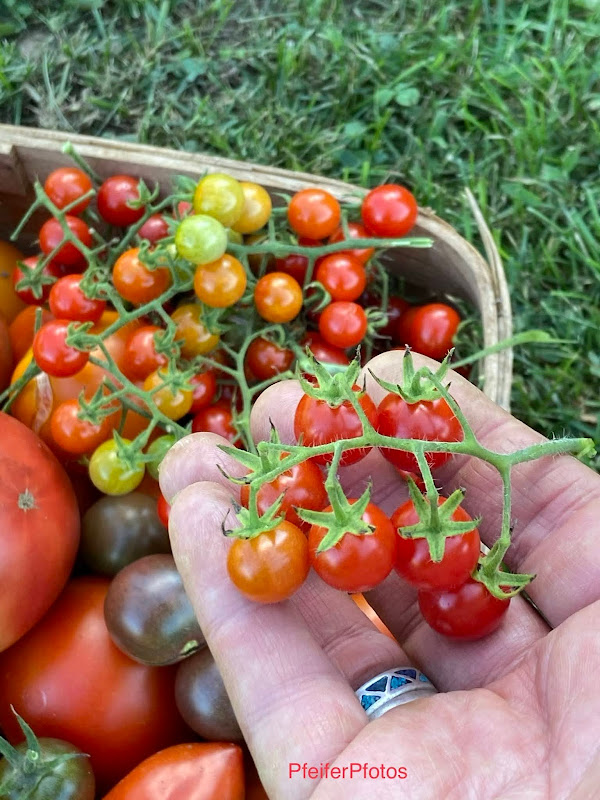
Heirloom Tomatoes (Including Cherokee Carbon, Big Brandy, Perfect Flame)


Matt's Wild Cherry (Heirloom)


Cherokee Purple (Good Example of How Heirlooms Can Be Irregular)


Black-Eyed Susan


Wonderful Blueberries


Bell peppers


Cayenne Peppers

Flox and Coreopis

Asters

Saturday, July 18, 2020

The Upper Garden

Welcome back.  Again it's been awhile since my last post, as I continue to be busy with gardening, and, oh yeah, working full time.  

In my last post I highlighted the lower garden, one of the 2 main gardens I plant.  I basically showed the whole planting process of that plot.  Since it's been almost a month, the upper garden is now well established so I will show up to date photos.  I did include the planting of peas in a previous post which are in the upper garden.

As is the lower garden, the upper is also packed with veggies.  In a year where I was going to cut back a little, well, it just didn't happen.  

Starting at the bottom, the upper garden starts off with peas as mentioned above.   These were planted on May 3rd, about a week before we got 3 inches of snow, the last snow of the season.  Due to the cold weather, only some of the peas came up.  Actually, it's amazing any came up.  So I replanted the ones that didn't germinate (pre-soaking them to speed up germination), and eventually I had a full row.

Finally the work paid off as I picked the first peas of the season,  We enjoyed them in a stir fry, they were so fresh and delicious.


Right next to the peas are a row each of scallions and leeks, both of which I started from seed.  The scallions are the Evergreen Bunching variety and the leeks are American Flag.  


As you can see, I also built another lettuce box out of scrap lumber from around the house.  This allows me to start a new batch of lettuce and greens to eventually replace the plants in the lower garden as we use them.  I have it covered in 30% shade cloth, as I do all the lettuce and kale at this time, to prevent the plants from growing too fast and/or bolting in the hot summer sun.

Next up are the potatoes.  I wanted to plant all Yukon Gold, however, I didn't initially buy enough seed potatoes for the whole plot.  By the time I went back to the local farm store for more, the Yukon Gold were all sold out.  I did manage to get some Kennebec which is a good white variety. My parents always grew Kennebec and were always happy with the results.  

From Wiki:  Kennebec is a medium- to late-maturing white potato. It was bred by the USDA and selected by Presque Isle Station, Maine, in 1941. 

From Wiki:  Yukon Gold is a large cultivar of potato most distinctly characterized by its thin, smooth, eye-free skin and yellow-tinged flesh.  

Both varieties generally yield well and also.store very well.


Overall I will end up with about 50 hills in the 4 rows.  As you can see, some didn't come up and I had to replant.  However, the replants are all sprouting so the end result will be good.  I already hilled the plants once.  I will do it again to ensure the new potatoes growing have plenty of soil to develop in without turning green.  Potatoes will turn green if exposed to sunlight.

Right above the potatoes are a row of green beans and also carrots.  The beans are a slender French type.  They are now blossoming and should be ready to pick in 10 days to 2 weeks.


Bean Blossoms
Bean Blossoms

The carrots I planted this year are from Burpee Seeds:

  
From the Burpee seed catalog:  We've combined five distinct colors of carrots in one special blend for a pretty rainbow effect that is sure to be noticed at the dinner table, even by the kids. After testing hundreds of carrot varieties, we developed this easy-to-grow mix of five crispy carrots: Atomic Red, Bambino, Cosmic Purple, Lunar White and Solar Yellow. Smoothly tapered roots grow to 8" x 2" in loose soil.

I am looking forward to harvesting these in the fall.

At the top edge of the garden are pumpkins, sunflowers, and pole beans.    

The last few seasons I have been having problems with sunflowers.  When planted, birds would eat the buried seeds right out of the ground, which I thought was very strange.  How do they know the seeds are a half inch under the soil?  Then, the plants were eaten off by woodchucks, the sunflowers being the only plants in both gardens that were bothered.  At times I have trouble with woodchucks, I am usually able to live trap and relocate them.

So this season I have had tried something new.  I built yet another box to use for the sunflowers.  After planting, it was covered with netting until the plants reached about 6 or 8 inches, then the netting removed, and the plants thinned and some moved outside the box.  So far so good.  I will keep a look out for varmits.

Some of the pumpkins I bought as plants, some were planted from seed.  I have Jack O Lantern and some other large varieties from Livingston Seed including Big Moon.


As always, thanks for reading.  More updates to come soon.